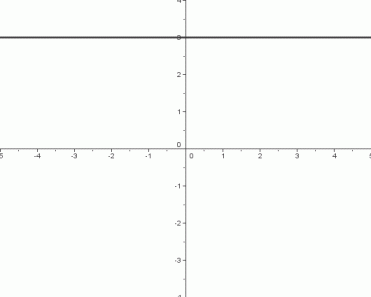
 |
| 0 Degree |
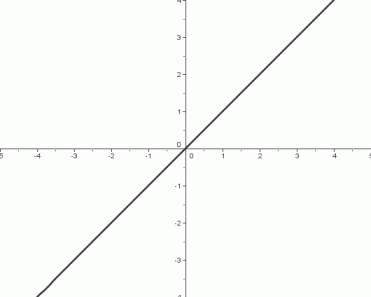 |
| 1st Degree |
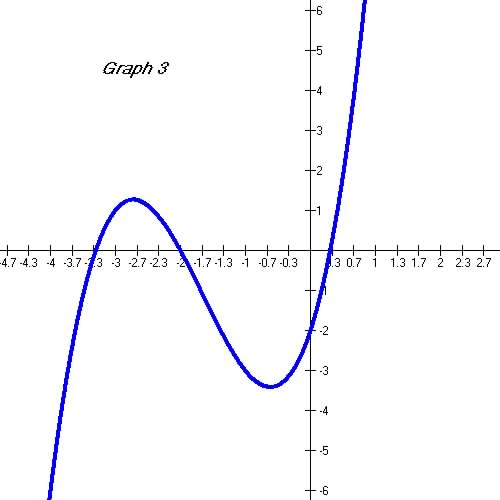 |
| 3rd Degree |
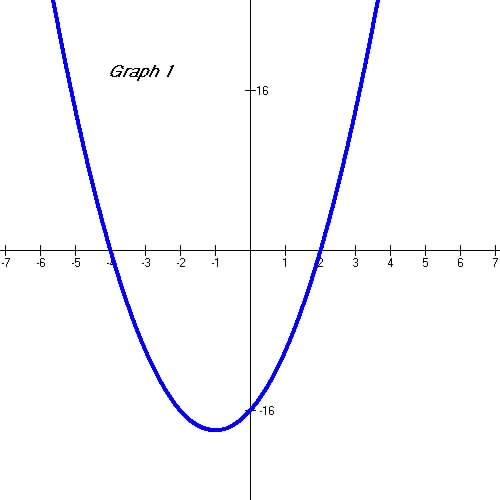 |
| 2nd Degree |
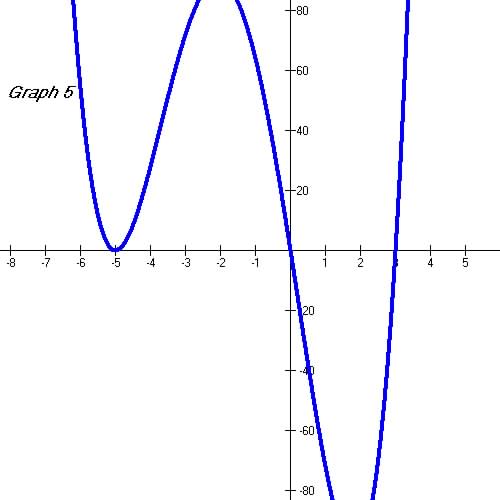 |
| 4th Degree |
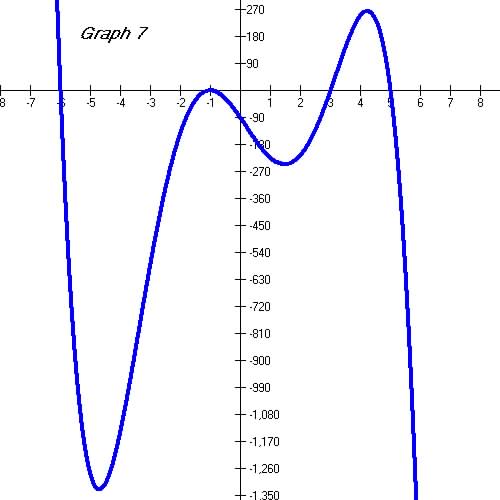 |
| 5th Degree |
Above are the graphs of varying polynomial functions. As you can see, as the degree of the function increases, the graph gets curvier. While this is not always the case, it is a general rule of thumb.
End Behavior
The ends of the graphs of the varying polynomial functions are actually pretty predictable. By looking at the leading coefficient of the term with the highest degree and the degree of the function, one can figure out how the function will look when graphed.
A positive leading coefficient will make the right side of the right most extreme on the graph ALWAYS approach infinity. This is written as such in limit notation:

A negative leading coefficient will make the right side of the right most extreme on the graph ALWAYS approach negative infinity. This is written as such in limit notation:

The opposite end of the graph either goes the same way as the right side or does the opposite. If the degree is EVEN, the left side acts the SAME as the right. If it is ODD, the left side acts the OPPOSITE of the right side.
Zeroes
A polynomial function has as many zeroes as its degree; however, it does not necessarily have that many X-Intercepts. A polynomial may have imaginary zeroes which are not graphed on the Cartesian plane.
Sometimes roots are repeated and can make a function that has two x intercepts only have one. This is called multiplicity.

This graph should have 4 X-Intercepts, however it only has 3. At X=0 the curve runs tangent to the X-Axis
Extrema
The graph of a polynomial function may have as many relative maxima/minima as (n-1) where n is the degree of the polynomial
Review
The graphs of polynomial functions have certain rules that allow you to predict what they will look like pretty easily. Knowing the degree and the leading coefficient allows you to make a sketch of the graph that will resemble the actual graph.


 must be a nonnegative integer (meaning it is a whole number and is equal to zero or is a positive integer-- no fractions or radicals!)
 ) have to be real numbers


 , 6 boxes of
  , and 8 boxes of 1.


