Wednesday, January 14, 2015

Real Zeros of Polynomial Functions

Long Division of Polynomials:
We probably all remember long division right? Well, in case you dont here's an example: If we want to divide 8932 by 17 with long division what we would do is 1st see how many times 17 goes into 89, then put that number on top of the bar. Then you subtract the remainder and continue on until 17 can no longer go into the last number. That number is the remainder(in this case 7), we divide this over the original divisor and add it to the quotient. This is the quotient of 8932/17:.
Long division of Polynomials is exactly the same, but with variables for example
/x-1
Would be done like this:
This works, but takes much longer than is necessary.
Synthetic Division of Polynomials:
This is a much more simplified way to find the roots of complex polynomials called synthetic division.
It is set up like this:
Now, what number are you supposed to use as a possible zero? All the possible zeros are the factors of the last term, P, divided by the factors of the first term, Q, like so:
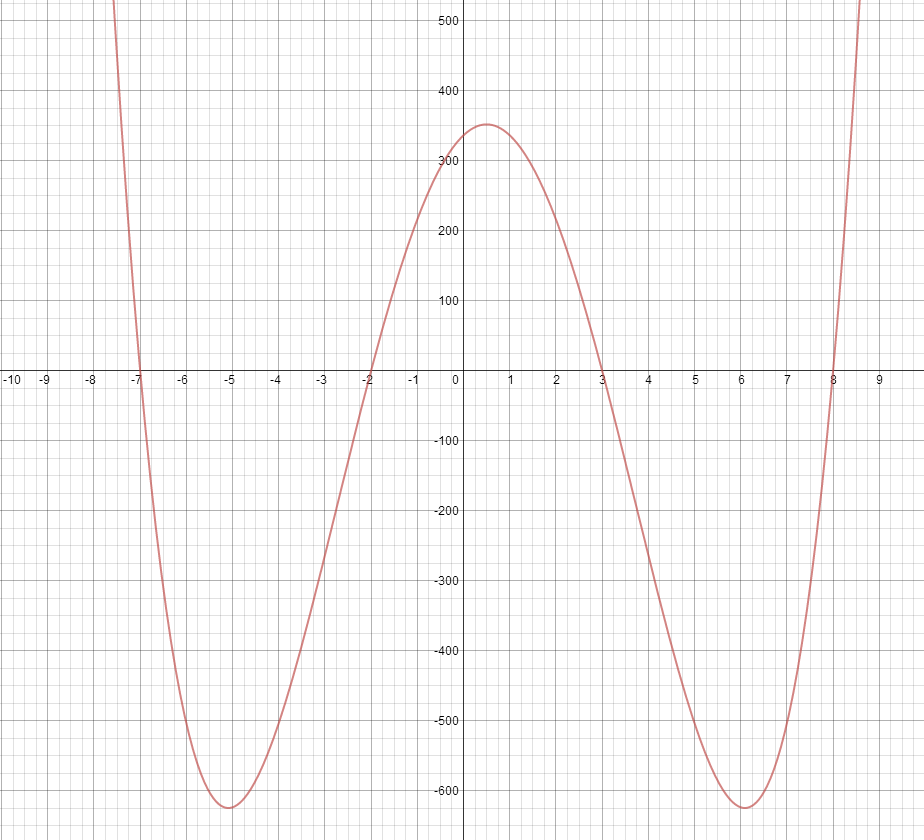
Calculating and plugging in these values, while still a shortcut, would still take ages. Yet again there is another shortcut. If you graph the equation, the points where it crosses the x axis, (zeros/x-intercepts) are the values which you should input, as the remainder will always be 0, meaning it is an x-intercept.
as we can see, the intercepts are, -7, -2, 3,8

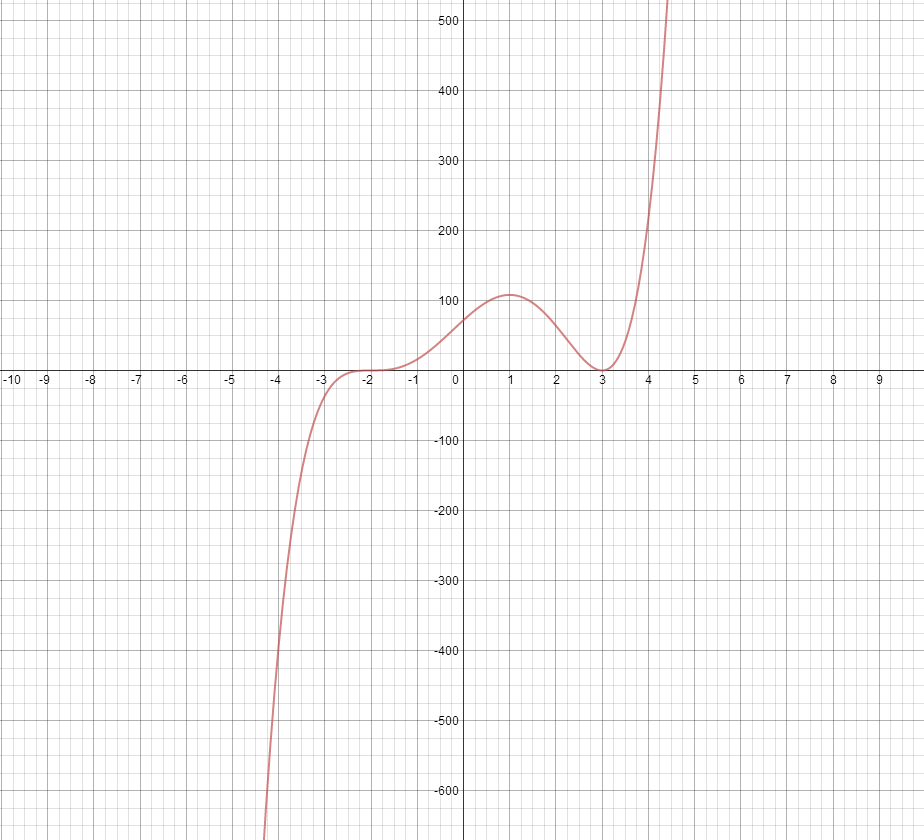
 Repeat this until you have a quadratic( make sure to use the new equation, not the original), then factor the quadratic as normal. It is very possible that if the graph runs tangent to the x-axis, or exhibits some other behaviors, that there are multiples of the x-intercepts like this:
in this case the intercept at (-2,0) has a multiplicity of 3, and at (2,0) has a multiplicity of 2. This means that you must enter the -2 into synthetic division 3 times, and 3 into synthetic division 2 times

Remainder theorem:
Now lets say your teacher gives you an function with many terms. Calculating the value of 
 
would take forever. However the remainder theorem states that that if a polynomial  is divided by
the remainder is


you thought there wouldn't be scrolling text, but there was


Tuesday, January 13, 2015

Polynomial Functions of Higher Degree


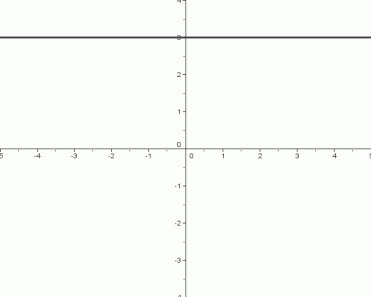
0 Degree
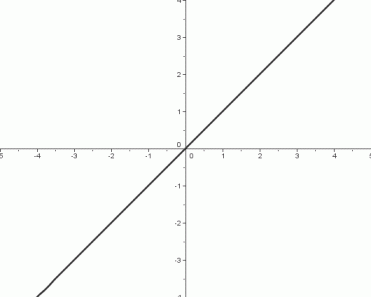
1st Degree
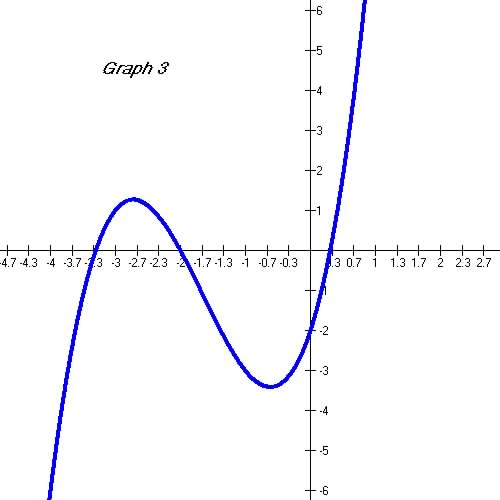
3rd Degree
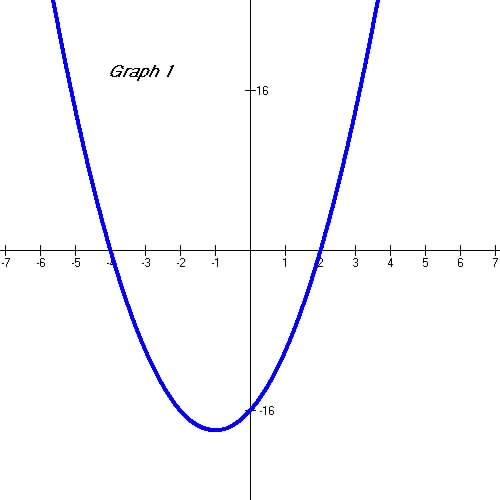
2nd Degree
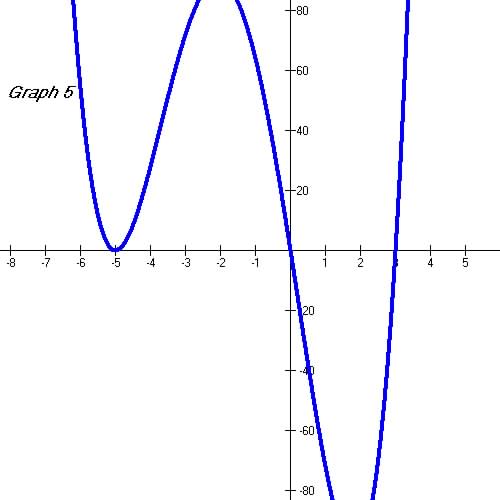
4th Degree
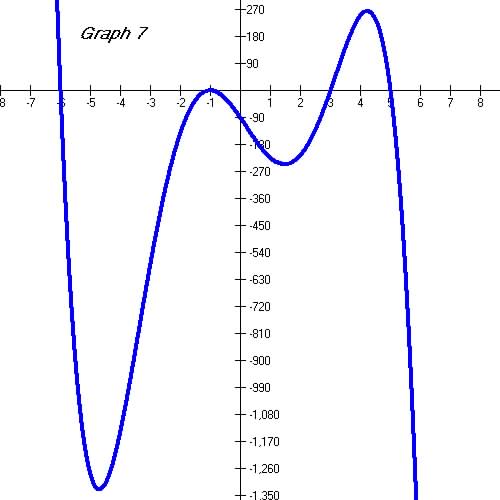
5th Degree


Above are the graphs of varying polynomial functions. As you can see, as the degree of the function increases, the graph gets curvier. While this is not always the case, it is a general rule of thumb.

End Behavior

The ends of the graphs of the varying polynomial functions are actually pretty predictable. By looking at the leading coefficient of the term with the highest degree and the degree of the function, one can figure out how the function will look when graphed.

A positive leading coefficient will make the right side of the right most extreme on the graph ALWAYS approach infinity. This is written as such in limit notation:

A negative leading coefficient will make the right side of the right most extreme on the graph ALWAYS approach negative infinity. This is written as such in limit notation:

The opposite end of the graph either goes the same way as the right side or does the opposite. If the degree is EVEN, the left side acts the SAME as the right. If it is ODD, the left side acts the OPPOSITE of the right side.

Zeroes

A polynomial function has as many zeroes as its degree; however, it does not necessarily have that many X-Intercepts. A polynomial may have imaginary zeroes which are not graphed on the Cartesian plane.

Sometimes roots are repeated and can make a function that has two x intercepts only have one. This is called multiplicity.

This graph should have 4 X-Intercepts, however it only has 3. At X=0 the curve runs tangent to the X-Axis

Extrema

The graph of a polynomial function may have as many relative maxima/minima as (n-1) where n is the degree of the polynomial


Review
The graphs of polynomial functions have certain rules that allow you to predict what they will look like pretty easily. Knowing the degree and the leading coefficient allows you to make a sketch of the graph that will resemble the actual graph.

Monday, January 12, 2015

POLYNOMIAL FUNCTIONS & COMPLETEING THE SQUARE


Polynomial Functions
DEFINED AS...
A polynomial function is of the form:
- the value of  must be a nonnegative integer (meaning it is a whole number and is equal to zero or is a positive integer-- no fractions or radicals!)
- all coefficients () have to be real numbers
- the degree of the polynomial is the highest value of  where 
- is continuous
- has a domain of all real numbers
EXAMPLE


Completing the Square

Completing the square involves taking a polynomial and rewriting it in standard form.
Standard form of a quadratic is  
For EXAMPLE... 
    To rewrite this polynomial function in standard form, we will visualize the terms of the polynomial as squares.
We need one box of , 6 boxes of , and 8 boxes of 1.
When lined up together based on similar sides, attempt to fill a square.

Looks like its a square short! So we need to add 1 (but you can't just add 1, so we will ADD 1 and SUBTRACT 1 to cancel out)


Another EXAMPLE...
Send the 13 far away!
We know in order for b to have a value of -10, and the two values have to be the same, it must be:
WHICH MEANS
Since we added 50 (the 25 x 2), we must subtract 50.
Giving us the final equation of 

Wednesday, January 7, 2015

Inverse Functions and One-to-One Functions

An inverse function is the relation formed when the dependent variable is exchanged with the independent variable in a given function.

Given function: 

\[f(x)=2x+1\]

How to find the inverse:

Switch the x and y values in the function.
f^{-1}(x)=2y+1

Then get y on its own
x-1=2y
y=\frac{x-1}{2}

Inverse function:
f^{-1}(x)=\frac{x-1}{2}


Two functions f and g are inverses of each other if
(fog)(x)=(x)

(gof)(x)=(x)

Will all functions have inverses that are also functions?

Not all functions will have inverses that are also functions.

How can you determine if a function's inverse is also a function?

1. Graph the function and its inverse

-The vertical line test will determine if f(x) is a function.
-The horizontal line test of a reflection of f(x) over the identity line will determine if a function's inverse g(x) has an inverse function.

-f(x) passes the vertical line test
-The inverse, g(x), passes the horizontal line test.
-The range of the inverse function is the domain of the original function.
Conclusion: the inverse of the function is also a function


-The inverse f^{-1}(x) is a reflection of the original function f(x) over the identity line y=x.
-The red sketch, 
f^{-1}(x) or g(x),
is the inverse relation of f(x)
.  
-Because the g(x) will not pass the horizontal line test for functions, f(x)
 does not have an inverse function.
Conclusion: The inverse relation exists, but it is NOT a function.


2. Determine algebraically if the function is one-to-one


A function f is One-to-One if, a and b in its domain, f(a) = f(b) that implies that a = b. To have an inverse, no two elements in the domain of
may correspond to the same element in the range of f


Two special functions that pass Horizontal Line Test
-If f is increasing on its entire domain, f is one-to-one.
-If f is decreasing on its domain, f is one-to-one.

Testing Algebraically

Let a and b be nonnegative real numbers with f(a)=f(b)
\sqrt{a}+1=\sqrt{b}+1
\sqrt{a}=\sqrt{b}
a=b

So f(a)=f(b) implies that 
a=b


Testing Graphically
Graph the function. 
You can see that a horizontal line will intersect the graph once at most


Key Points


  • To find inverse
    • use horizontal line test to decide whether f has an inverse
    • in the equation of f(x), replace f(x) by y
    • interchange the roles of x and y, and solve for y
    • Replace y by f^{-1}(x) in the new equation
    • Verify that f and f^{-1}(x) are inverses of each other by showing that f(f^{-1}(x))=x and f^{-1}(x)=x
  • The graph of a function is reflected over the identity line to form the graph of its inverse
  • only functions that pass the horizontal line test will inverses that are functions
  • a function is one-to-one if f(a)=f(b) implies a=b


Wednesday, December 17, 2014

Composition of Functions

Composition of Functions Composition is when we take the output of one function and use it as the input for another function. Another way to state this is h(x) = f(g(x)), or:


Note: This is pronounced "f of g of x", not "fog x".

Let's take a look at an example of composition. For this example, we will use:


Composition is defined as:


First, we fill in f and g:


Then, we simplify, getting:


To find the domain of a composite function, we need to first find the domain of g(x). Then, since we are putting the results of g(x) into f(x), we need to find which results of g(x) are in the domain of f(x). If x is in the domain of g(x), and g(x) is in the domain of f(x), then x is in the domain of h(x).

For example:


Filling in f and g, we get:


Since the denominator of g(x) cannot equal 0, x cannot equal 5. Therefore, the domain of g is (-∞, 5) ∪ (5, ∞). But we're not done yet. We cannot have a negative under the square root in f, so we can exclude numbers less than -3 from the domain of f. But, since this is a composite function, g(x) is the domain of f, so g(x) cannot be less than -3. By excluding all x that would make g(x) less than -3, we have the domain of (f ○ g) (x), which is:


Things to Remember:
1. (f g) (x) is pronounced "f of g of x", not "fog x".
2. Always remember to put parentheses in the right places.